
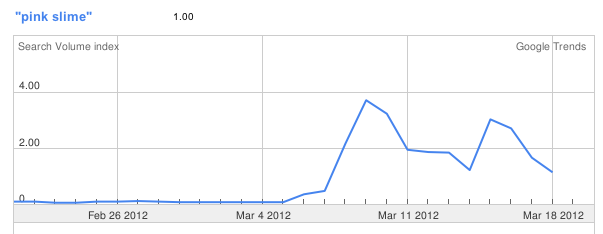
Have you heard the term “pink slime” recently? Chances are you’ve seen it mentioned on TV or Facebook or maybe in discussions with friends. But here’s a question: How much were you talking about pink slime a year ago? Most likely you had never heard the term “pink slime” a year ago and chances are that you won’t be talking about it a year from now. This current food safety trend (which isn’t even a food safety story as no one has been harmed by eating it) has exploded in recent weeks. This is due to the social media sphere and TV coverage of Jamie Oliver’s over-exaggerated video clip where he shows kids and moms where ground beef comes from. Nothing has changed in beef processing in quite a while. Chopping, grinding and blending animal parts together in enormous factories is nothing new and is the defacto method used for mass producing food. So why all the sudden outrage regarding “pink slime”? Below is a chart showing the volume of Google searches for “pink slime” in the last 30 days.
Similarly, here is a chart that shows the viewing trends for the most popular version of Jamie Oliver’s video clip about pink slime:
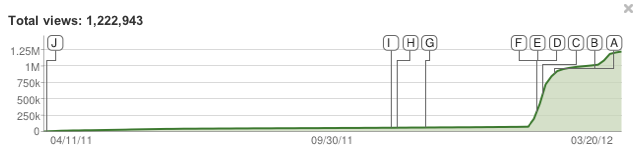
Translation: No one was talking about this a few months ago. And chances are you haven’t thought twice about buying ground meet until last week. Just to recap: No one has become sick or died from consuming this “pink slime’ substance (It’s called BLBT, “Boneless Lean Beef Trimmings”). No one has recalled anything. No Salmonella, no E. coli. In fact, the “puff of ammonia” that Jamie Oliver and others criticize is used in food processing to kill Salmonella and E. coli in the first place. Would they rather it not be used? The paradox is obvious upon further inspection but what this media spectacle illustrates is that consumers make decisions about what not to eat (pink slime) just as blindly and capriciously as when they don’t know anything at all about where a food comes from. Do you know who’s not showing up in Google searches for pink slime? The USDA. The FDA. Consumers and the industry should be learning a few things during “Slimageddon 2012.” First, consumer opinion is informed just as much by the entertainment media as they are “official” sources like the meat industry or government agencies. Second, brands, companies and associations should be poised to respond during a food safety crisis (or perceived one) and communicate not just the facts but also the necessary sentiment to be heard by consumers. Third, images and video are crucial to public perception and are more important than words.
Bonus: Here are the opposing sides in the pink slime war, facing off with their various videos.
American Meat Institute
- Says BLBT is sustainable, creates more food for increasing demand
- Shows meat that actually looks pretty tasty, like a plain-old steak
- Plays Mom card at the end: “I have 2 burger-loving boys”
- Says using BLBT is the right thing to do, stops waste
- Quotable: “I want to address these wild Internet rumors…”
Jamie Oliver
- Spray paints a live cow (Where was PETA for this one?)
- Uses kids making “yuck” faces
- Fails to mention chocolates, dairy, fruit and vegetable industry for similar processes
- Quotable: “I don’t know how much…there’s a specific ratio but basically they wash this meat…”
SOURCES
http://www.meatami.com/ht/a/GetDocumentAction/i/63785